

Table of contents
Discover the differences between Frontend and Backend development, their job market demand, and the career opportunities each offers.

Choosing between frontend and backend development is one of the most common decisions for aspiring web developers. Both specializations offer interesting career opportunities, but they require different technical skills and address different business needs. So, when comparing frontend vs backend, which specialization is more in demand in today's job market ?
Backend development currently shows a stronger hiring signal in some recruitment surveys, while frontend development remains an essential part of web projects. The difference depends on the industry, location, experience level, and technologies involved. Full-stack developers are also attractive to employers because they can work across both sides of an application.
01Frontend vs Backend : Understanding the main differences
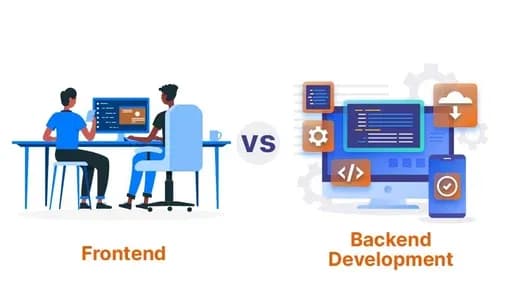
Although frontend and backend developers work on the same digital product, their responsibilities are different. One focuses on what users see and interact with, while the other manages the systems that make the application function.
Understanding these roles is essential before comparing their employment opportunities.
What is frontend development ?
Frontend development involves building the visual and interactive elements of a website or web application. It determines how users navigate a platform, interact with its features, and experience its content.
A frontend developer transforms design concepts into functional interfaces that work across different devices and screen sizes.
Their main responsibilities include :
- Building website layouts and user interfaces.
- Implementing responsive design for desktop, tablet, and mobile.
- Developing interactive elements such as menus, forms, and buttons.
- Improving website performance and loading speed.
- Ensuring browser compatibility and accessibility.
- Connecting interfaces to backend services through APIs.
Common frontend technologies include HTML, CSS, JavaScript, TypeScript, React, Angular, Vue.js, and Next.js.
What is backend development ?
Backend development focuses on the server-side logic and infrastructure that operate behind a website or application. It ensures that information is processed correctly, stored securely, and delivered to the frontend when needed.
A backend developer builds and maintains the systems responsible for application functionality.
Typical responsibilities include :
- Developing server-side application logic.
- Designing and managing databases.
- Building and maintaining APIs.
- Implementing authentication and authorization.
- Protecting sensitive information.
- Managing application performance and scalability.
- Integrating third-party services and business systems.
Popular backend technologies include Python, Java, PHP, C#, Node.js, Ruby, Django, Laravel, Express.js, and Spring Boot.
02Frontend vs Backend : A detailed comparison
The main difference between these two specializations lies in their objectives, technical environments, and daily responsibilities.
The following table highlights the most important distinctions.
Comparison criteria | Frontend development | Backend development |
Main focus | User interface and experience | Server-side functionality |
Development area | Client-side | Server-side |
Main languages | HTML, CSS, JavaScript | Python, Java, PHP, C# |
Popular frameworks | React, Angular, Vue.js | Django, Laravel, Spring Boot |
Main tools | Browser DevTools, Figma, npm | Postman, Docker, database tools |
Data management | Displays and sends data | Stores, processes, and retrieves data |
Security responsibilities | Interface-level protection | Authentication, authorization, data security |
Performance focus | Rendering and loading speed | Server response and database efficiency |
Testing | UI and browser testing | API, integration, and server testing |
Main objective | Improve user experience | Ensure reliable application functionality |
How do frontend and backend work together ?
Consider an e-commerce website where a customer wants to purchase a product.
The frontend displays the product catalogue, shopping cart, and checkout page. When the customer confirms an order, the backend processes the request, checks product availability, calculates the total, and communicates with the payment service.
The frontend then displays the order confirmation.
This interaction demonstrates why both specializations are necessary. A visually attractive website cannot operate effectively without reliable backend services, and a powerful backend cannot deliver a good user experience without a functional interface.
03Which is more in demand : Frontend or Backend development ?
When comparing frontend vs backend demand, backend development currently has an advantage in some recruitment data. However, this does not mean frontend developers are less valuable or that their opportunities are disappearing.
The 2025 CoderPad and CodinGame State of Tech Hiring report provides a useful indication of employer demand. Among recruiters surveyed, the technical positions they were looking to hire included:
- Backend developers: 41.74%.
- Full-stack developers: 40.34%.
- Frontend developers: 27.26%.
These figures represent recruiter responses, not the percentage of all available vacancies worldwide. Nevertheless, they suggest that backend and full-stack profiles were particularly sought after in that survey.
Why is backend development attracting strong demand ?
Modern applications require increasingly sophisticated server-side systems. Businesses need secure platforms that can manage large amounts of information, process transactions, and connect multiple services.
Several factors contribute to this demand :
- API development: Businesses need reliable APIs to connect websites, mobile applications, and external platforms.
- Data management: Applications depend on databases to store, retrieve, and organize information.
- Cybersecurity: Authentication, access control, and data protection are essential for business applications.
- Cloud infrastructure: Companies need scalable systems that can handle changing workloads.
- Artificial intelligence: AI-powered applications often require backend services to manage models, data, and integrations.
These requirements make backend expertise particularly valuable in SaaS platforms, fintech, e-commerce, enterprise software, and data-intensive applications.
Why is frontend development still important ?
Every customer-facing digital product needs an accessible and functional interface. Businesses cannot rely on backend performance alone to attract and retain users.
Demand for frontend developers remains supported by several factors:
- The continuous development of websites and web applications.
- The growth of mobile-friendly and responsive interfaces.
- The need for better user experience and accessibility.
- The expansion of interactive dashboards and customer portals.
- The adoption of modern JavaScript frameworks.
For example, an online banking platform requires frontend developers to create clear account dashboards and transaction interfaces, while backend developers manage balances, authentication, and financial operations.
The conclusion: Backend development has a stronger hiring signal in the cited recruitment survey, but frontend development remains a core requirement for building competitive digital products.
04Which technologies are most in demand in 2026 ?
The demand for developers is closely connected to the technologies businesses use to build and maintain their applications.
According to the Stack Overflow Developer Survey, JavaScript remains one of the most widely used programming languages, while Python continues to play an important role in backend development, automation, and artificial intelligence.
Popular frontend technologies
JavaScript remains fundamental to interactive web development. However, employers also look for developers who understand modern frameworks and development practices.
Technology | Main purpose |
HTML5 | Structuring web pages |
CSS3 | Styling and responsive layouts |
JavaScript | Interactive website functionality |
TypeScript | More structured JavaScript development |
React | Building reusable user interfaces |
Angular | Developing structured web applications |
Vue.js | Building interactive interfaces |
Next.js | Developing React-based web applications |
Learning React, TypeScript, and Next.js can help developers build more advanced frontend projects and understand modern application architectures.
Popular backend technologies
Backend development offers several technology paths depending on the type of application and business environment.
Technology | Main purpose |
Python | Backend applications, automation, and AI integrations |
Node.js | JavaScript-based server-side development |
PHP | Dynamic websites and web applications |
Java | Enterprise applications |
C# | Business applications and Microsoft-based environments |
Laravel | PHP application development |
Django | Python web development |
Spring Boot | Java-based backend systems |
Developers should also understand SQL, PostgreSQL, MySQL, MongoDB, REST APIs, Docker, and cloud computing.
The Stack Overflow survey highlights the continued adoption of technologies such as Node.js, React, PostgreSQL, and Docker, reflecting the importance of both application development and infrastructure skills.
05Frontend vs Backend : salary, career growth, and job opportunities
Salary is another important consideration when choosing between frontend and backend development.
However, there is no universal rule stating that backend developers always earn more than frontend developers. Compensation depends on several factors, including:
- Professional experience and technical expertise.
- Country and local employment market.
- Company size and industry.
- Complexity of the projects handled.
- Knowledge of specialized technologies.
- Ability to manage responsibilities independently.
Frontend developer career opportunities
Frontend developers can progress toward several positions as their technical experience increases:
- Junior Frontend Developer.
- Frontend Developer.
- Senior Frontend Developer.
- UI Engineer.
- Frontend Architect.
- Technical Lead.
Developers who combine frontend expertise with accessibility, performance optimization, and user experience knowledge can also access more specialized opportunities.
Backend developer career opportunities
Backend developers can develop expertise in application architecture, databases, infrastructure, and system performance.
Possible career paths include :
- Junior Backend Developer.
- Backend Developer.
- Senior Backend Developer.
- Software Engineer.
- Backend Architect.
- Cloud Engineer.
- Technical Lead.
Experienced backend developers may also specialize in microservices architecture, cloud computing, cybersecurity, distributed systems, and database optimization.
Which specialization offers better long-term growth ?
Both specializations provide opportunities for professional development. The strongest career prospects often come from combining technical expertise with an understanding of complete application architecture.
For example, a backend developer who understands frontend integration can collaborate more effectively with product and design teams. Similarly, a frontend developer who understands APIs, databases, and server-side logic can make better technical decisions.
06Frontend, backend, or full-stack : Which should you choose ?
The right specialization depends on your interests, learning preferences, and professional objectives.
Before choosing, consider the following differences.
Choose frontend development if you :
- Enjoy visual design and creative problem-solving.
- Like building interfaces that people interact with.
- Are interested in user experience and accessibility.
- Prefer working with browser technologies.
- Enjoy seeing the results of your work directly on screen.
Choose backend development if you :
- Enjoy logical and analytical problem-solving.
- Are interested in databases and data structures.
- Like designing application architecture.
- Want to work on security and system performance.
- Prefer developing functionality that operates behind the interface.
Consider full-stack development if you :
- Want to understand the complete development process.
- Enjoy working with both interfaces and server-side systems.
- Are interested in developing independent projects.
- Want to collaborate across different technical teams.
A full-stack developer works with both frontend and backend technologies. This profile can be particularly useful for startups and small development teams that need professionals capable of handling multiple parts of an application.
However, becoming a full-stack developer does not necessarily mean mastering every technology. It requires a solid understanding of both environments and the ability to build and integrate functional applications.
A practical checklist for choosing your specialization
Use these five questions to identify the direction that best matches your interests:
- Do you enjoy visual interfaces more than server-side logic?
- Are you more interested in design and interaction or data processing?
- Do you prefer JavaScript-based interfaces or server-side programming?
- Are you interested in databases, APIs, and application architecture?
- Would you rather specialize deeply or work across the entire application?
Your answers can help you identify a starting point. You can always expand your skills later as your experience grows.
07Common mistakes when choosing between frontend and backend
Choosing a specialization based only on current trends can lead to unrealistic expectations. Before investing time in a particular technology, avoid these common mistakes.
Choosing based only on salary
A higher salary in one job listing does not mean the entire specialization pays better. Compare roles at similar experience levels and within the same geographical market.
Learning too many technologies at once
Trying to master React, Angular, Python, Java, and several databases simultaneously can slow down your progress.
Start with a focused technology stack, build practical projects, and expand your knowledge gradually.
Ignoring fundamental programming concepts
Frameworks change, but essential concepts remain valuable. Understanding programming logic, data structures, APIs, debugging, and version control helps developers adapt to new technologies.
Overlooking collaboration skills
Frontend and backend developers rarely work in complete isolation. Communication, documentation, teamwork, and problem-solving are essential in professional development environments.
Ignoring real business requirements
A technology should solve a particular problem rather than simply follow a trend. Understanding what a business needs helps developers make better architectural and technical decisions.
For companies, selecting the right development approach is equally important. The choice between frontend, backend, and full-stack expertise should reflect the project's complexity, available resources, scalability requirements, and long-term objectives.
08How can businesses choose the right web development team ?
For businesses, the decision between frontend and backend development should be based on the product's objectives rather than the popularity of a particular specialization.
A company developing a corporate website may prioritize frontend development, responsive design, and content management. On the other hand, an enterprise platform may require more backend expertise to manage databases, business processes, user permissions, and integrations.
Before starting a development project, businesses should evaluate:
- Project requirements: Identify the features, functionalities, and user interactions the application needs.
- Technical architecture: Determine which frontend frameworks, backend technologies, and databases are appropriate.
- Scalability: Consider how the application will handle increasing users, data, and transactions.
- Security: Define authentication, authorization, and data protection requirements.
- Integration needs: Identify connections with payment gateways, ERP systems, CRM platforms, and external APIs.
- Maintenance: Plan for testing, updates, technical support, and future improvements.
Working with an experienced development team helps businesses make these decisions before implementation. It also reduces the risk of choosing technologies that do not match their operational needs.
For companies planning a new digital product or upgrading an existing platform, RKTEC Solution's web and mobile development services cover the technical development of digital solutions, from application requirements to implementation.
09Conclusion : Frontend vs Backend – Which is more in demand?
When evaluating frontend vs backend, backend development currently demonstrates stronger hiring demand in the recruitment survey discussed above. However, frontend developers continue to play an essential role in creating accessible, responsive, and engaging digital experiences.
The best specialization depends on your interests, technical abilities, and career objectives. Frontend is a natural choice for developers interested in interfaces and user experience, while backend suits those who enjoy application logic, databases, and system architecture.
For businesses, the real priority is finding the right balance between both disciplines. A successful digital product needs a well-designed interface and a reliable technical foundation.
Planning a website or web application ? RKTEC Solution can help you define your technical requirements, select suitable technologies, and build a solution aligned with your business objectives. Get in touch with the team to discuss your project and explore the right development approach.
10FAQ
Is frontend or backend development more in demand ?
Backend development showed stronger hiring demand than frontend development in the 2025 CoderPad and CodinGame recruiter survey. However, demand varies by industry, location, and experience. Both specializations remain important because modern web applications require functional interfaces and reliable server-side systems.
Is frontend development easier than backend development ?
Frontend development can be easier to visualize because developers immediately see the results of their work in a browser. However, mastering responsive layouts, JavaScript, accessibility, and complex interfaces requires considerable practice. Backend development involves different challenges, including databases, security, APIs, and application architecture.
Should I learn frontend or backend first ?
Beginners can start with frontend development by learning HTML, CSS, and JavaScript, which provide a practical introduction to web technologies. Those interested in programming logic and data management may prefer backend development with Python or Java. The best starting point depends on personal interests and learning objectives.