


Table of contents

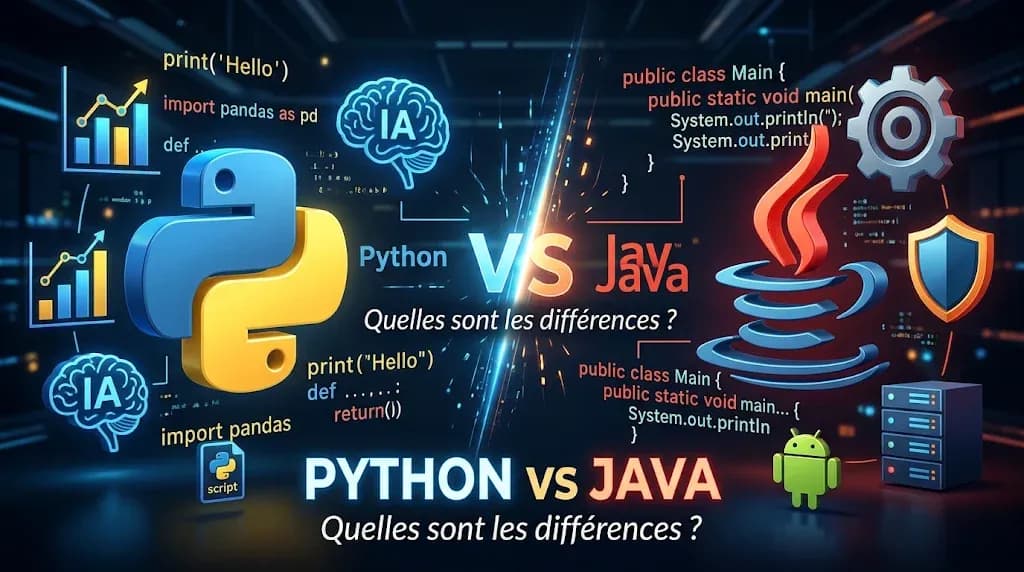
Are you trying to decide between Python and Java for learning programming or developing an application? Both languages are among the most widely used programming technologies, but they serve different purposes. Python stands out for its simplicity and development speed, while Java is valued for its robustness, performance, and ability to handle complex applications.
Python is generally a better choice for artificial intelligence, data science, automation, and rapid prototyping. Java is often more suitable for enterprise applications, complex systems, and software that requires a robust architecture. The best choice ultimately depends on your project's requirements, technical constraints, and long-term goals.
01Python and Java: An Overview of Both Programming Languages
Before comparing their performance and features, it is important to understand the philosophy behind each programming language.
What is Python?
Python is a general-purpose programming language created in 1991 by Guido van Rossum. It is known for its simple syntax, readability, and flexibility.
Unlike many programming languages that require relatively complex syntax, Python allows developers to write instructions using fewer lines of code. This makes it easier to learn and speeds up application development.
Python is widely used in several fields:
- Artificial intelligence (AI) and machine learning.
- Data science and data analysis.
- Web development with Django, Flask, and FastAPI.
- Task automation and script development.
- Scientific computing and data processing.
Its ecosystem includes numerous libraries, particularly NumPy, Pandas, TensorFlow, and PyTorch.
What is Java?
Java is an object-oriented programming language introduced in 1995 by Sun Microsystems. It was designed to support the development of portable, robust, and scalable applications.
Its execution model relies on the Java Virtual Machine (JVM), which allows Java bytecode to run on different compatible operating systems.
Java is widely used for:
- Enterprise applications and management systems.
- Back-end development with Spring Boot.
- Android applications, although Kotlin is now the preferred language for modern Android development.
- Banking and financial platforms.
- Distributed systems and microservices architectures.
Its static typing system and mature ecosystem make Java particularly suitable for projects that require a structured and reliable technical environment.

02Python vs Java: What Are the 7 Main Differences?
Python and Java share several characteristics. Both are cross-platform, versatile programming languages that support object-oriented programming. However, their differences directly affect how applications are developed, tested, and maintained.
Here are the seven key criteria to consider when comparing them.
Syntax and Code Readability
The first major difference lies in how developers write instructions.
Python uses concise syntax that makes code easier to read. It relies on indentation to organize blocks of instructions.
Java follows a more structured syntax, using curly braces, semicolons, and explicit type declarations.
For example, displaying a message in Python requires just one instruction:
print("Hello, welcome!")
In Java, the same operation requires more code:
public class Main {
public static void main(String[] args) {
System.out.println("Hello, welcome!");
}
}
Verdict: Python is more concise and generally easier for beginners to read. Java requires more structure, which can be beneficial when organizing complex applications.
Typing System: Dynamic vs Static
A programming language's typing system determines how variables are declared and checked.
Python uses dynamic typing, meaning that a variable's type is determined at runtime. Developers generally do not need to declare variable types explicitly.
Java uses static typing, meaning that variable types are declared and primarily checked during compilation.
Python example:
age = 25
age = "Twenty-five"
Python allows the variable to change its type.
Java example:
int age = 25;
A variable declared as an integer cannot directly receive a string value.
Verdict: Python offers greater flexibility during development. Java helps detect certain type-related errors before execution, making it easier to manage large-scale projects.
Performance and Execution Speed
Performance is an important consideration, especially for applications that process large amounts of data or need to respond quickly to users.
Java benefits from bytecode compilation and Just-In-Time (JIT) optimizations provided by the JVM. These mechanisms generally deliver strong performance for applications that run continuously over long periods.
Python, particularly its standard CPython implementation, can be slower for computationally intensive operations. However, optimized libraries written in C or C++ can deliver excellent performance for specific workloads.
It is therefore important to distinguish between program execution speed and development speed.
Verdict: Java generally has an advantage in CPU-intensive workloads and applications requiring high throughput. Python can also perform very well when supported by optimized libraries and a well-designed architecture.
Learning Curve and Developer Productivity
A programming language's simplicity influences how long it takes to train a development team and build the first version of a product.
Python is often recommended to beginners because of its intuitive syntax. It allows learners to understand fundamental programming concepts relatively quickly.
Java requires more initial knowledge, particularly regarding classes, objects, interfaces, and data types.
For businesses, this difference can also affect development timelines.
Verdict: Python generally makes prototyping and building an initial product version faster. Java offers a more structured development environment, with useful tools for organizing large-scale projects.
Available Frameworks and Libraries
Frameworks and libraries allow developers to build features without starting from scratch.
Field | Python | Java |
Web development | Django, Flask, FastAPI | Spring Boot, Quarkus |
Artificial intelligence | PyTorch, TensorFlow | Deeplearning4j, DJL |
Data analysis | Pandas, NumPy | Apache Spark, specialized libraries |
Automated testing | Pytest, unittest | JUnit, TestNG |
Dependency management | pip, Poetry, uv | Maven, Gradle |
Python has a particularly rich ecosystem for AI, machine learning, and data science.
Java offers mature frameworks for business applications, APIs, and enterprise architectures.
Verdict: The right choice mainly depends on the features you need to build and the tools your development team already uses.
Security, Maintenance, and Scalability
A software project does not end once it has been developed. It must be able to evolve, support new features, and remain maintainable over several years.
Java provides a structured environment through static typing, development tools, and a comprehensive testing ecosystem. These characteristics are particularly useful for projects involving multiple developers.
Python can also be used to build secure and scalable applications. However, developers should follow established coding conventions and use type annotations, automated tests, and code quality tools.
In both languages, security also depends on architecture quality, access management, dependency management, and regular updates.
Verdict: Java provides a particularly suitable environment for complex enterprise systems. Python is also appropriate for scalable applications when developers follow good engineering practices.
Community and Career Opportunities
Both Python and Java have large international communities, extensive learning resources, and established job markets.
However, career opportunities vary depending on the specialization.
- Python: Python developer, AI engineer, data analyst, data scientist, back-end developer, and automation engineer.
- Java: Java developer, software engineer, back-end developer, Java consultant, and enterprise application developer.
Python is particularly востребed in projects involving artificial intelligence and data. Java continues to play an important role in information systems, financial services, and business applications.
Verdict: Both languages offer attractive career opportunities. Your choice should reflect the professional field in which you want to specialize.
03Python vs Java: Comparison Table
To quickly understand the differences between these two technologies, here is a summary of their main characteristics.
Criteria | Python | Java |
Release year | 1991 | 1995 |
Language type | High-level, multi-paradigm | High-level, object-oriented |
Typing system | Dynamic | Static |
Syntax | Simple and concise | More structured |
Execution | Bytecode executed by an interpreter | Bytecode executed by the JVM |
Performance | Varies depending on workload | Generally stronger in CPU-intensive workloads |
Learning curve | Beginner-friendly | More demanding |
Web development | Django, Flask, FastAPI | Spring Boot, Quarkus |
Artificial intelligence | Extensive ecosystem | More specialized ecosystem |
Enterprise applications | Suitable depending on architecture | Widely used |
Maintenance | Depends on development practices | Static typing and structured tooling |
Mobile applications | Less common solutions | Used for Android, although Kotlin is preferred for modern development |
This comparison shows that there is no universal winner. Python prioritizes simplicity and productivity, while Java provides a robust foundation for complex systems.
04When Should You Choose Python or Java for Your Project?
The best programming language depends on the nature of your digital product, its expected features, and its technical requirements.
When Should You Choose Python?
Python is a suitable choice when your project involves:
- Developing an automation tool.
- Building an artificial intelligence solution.
- Analyzing and processing large datasets.
- Quickly developing a prototype or minimum viable product (MVP).
- Creating a web application with Django or FastAPI.
Practical example: A company wants to develop a tool that automatically analyzes sales data, identifies trends, and generates reports. Python is particularly suitable because of its specialized data science libraries.
When Should You Choose Java?
Java is particularly useful when your project involves:
- A business application with multiple modules.
- A banking or financial platform.
- A complex back-end system.
- An architecture based on multiple microservices.
- An application requiring high concurrent processing capacity.
Practical example: A company wants to develop a management platform that centralizes orders, inventory, payments, and user accounts. Java can be an excellent choice for structuring the different modules and making long-term maintenance easier.
05Can You Use Python and Java in the Same Project?
Yes. Both programming languages can work together within the same software architecture.
For example, a company could use Java to manage the core operations of its application and Python to develop an AI-powered recommendation engine.
The two components can communicate through REST APIs, message queues, or other integration mechanisms.
This approach allows businesses to benefit from the strengths of both technologies. However, it also introduces additional complexity related to deployment, monitoring, communication security, and maintaining multiple development environments.
06How to Choose Between Python and Java: A 5-Step Checklist
Before selecting a technology, it is best to clearly define your project's requirements.
Here is a checklist to help you make the right decision.
Step 1: Define the Expected Features
List the main features your application needs, such as user management, payments, dashboards, automation, data analysis, or artificial intelligence.
Step 2: Evaluate Performance Requirements
Identify the expected number of users, the volume of data to be processed, and response time requirements. Systems involving intensive processing may require particular attention to performance.
Step 3: Assess Your Team's Skills
Choosing a programming language that your developers already know can reduce development time and training costs.
Step 4: Anticipate Future Project Requirements
A prototype designed to validate an idea does not have the same requirements as a platform expected to support numerous modules and integrations.
Step 5: Compare the Total Cost
Do not focus exclusively on initial development costs. Also consider:
- Hosting and infrastructure.
- Licenses and third-party services, where applicable.
- Bug fixes and ongoing maintenance.
- Testing and security.
- Developer recruitment and training.
The right choice is the one that provides the best balance between functional requirements, performance, budget, and long-term maintenance.
07Python or Java for Web Development and Business Applications?
For a business, choosing between Python and Java is a technical decision that can influence the quality and future development of its digital product.
Both languages can be used to develop web applications, APIs, and professional software solutions. However, they do not always address the same requirements.
Python is particularly useful for quickly building web applications, platforms with AI-powered features, and data management tools.
Java is especially relevant for complex business applications, systems requiring numerous integrations, and large-scale back-end architectures.
It is also important to remember that choosing the right programming language alone does not guarantee a successful project. User experience, database design, security, server performance, and code quality are equally important.
For an e-commerce business, the technology choice must also account for sales features, order management, and future scalability. Developing an e-commerce website requires careful consideration of payment gateway integration, inventory management, transaction security, and the overall shopping experience.
If you are planning to establish your online presence, it is also useful to understand the different website creation options and the steps involved before getting started.
08Python vs Java: Which Programming Language Should You Choose in 2026?
So, Python or Java: which one should you choose?
The answer depends primarily on your goals.
Python stands out for its simplicity, flexibility, and capabilities in artificial intelligence, data science, and automation. Java remains a leading choice for enterprise applications, complex systems, and architectures that require a highly structured development environment.
For businesses, the most important thing is not choosing the most popular programming language, but selecting the technology that genuinely meets their current and future requirements.
At RKTEC Solution, we help businesses design and develop digital solutions tailored to their goals. From requirements analysis to technical architecture selection, our team can help you build a coherent, scalable solution that fits your business needs.
Are you planning to develop a website, digital platform, or business application? Contact RKTEC Solution to discuss your requirements and find the right development approach for your project.
For entrepreneurs looking to get started with a limited budget, our guide on how to create a free website explains the available options, their limitations, and how to move towards a professional website as your business grows.
09FAQ: Python vs Java
Python vs Java: Which Is Easier to Learn?
Python is generally easier to learn because of its concise and readable syntax. It allows beginners to understand programming fundamentals quickly. Java requires greater attention to syntax and a deeper understanding of object-oriented programming, but it also provides a valuable technical foundation.
Python vs Java: Which Is Faster?
Java is generally faster than Python for CPU-intensive operations, particularly because of JVM optimizations. However, performance depends on the application, its architecture, and the libraries used. Python can be highly efficient when supported by optimized components.
Can You Use Python and Java to Develop a Website?
Yes. Both languages can be used to develop web applications. Python offers frameworks such as Django and FastAPI, while Java provides frameworks such as Spring Boot. The choice depends on the expected features, available technical skills, performance requirements, and maintenance considerations.